Execution
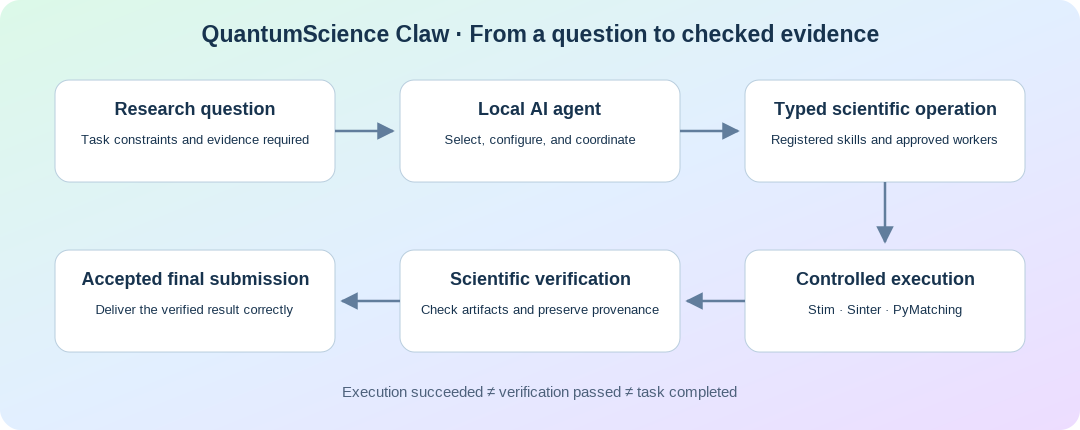
The scientific software runs and produces an artifact.
A locally deployed scientific agent for verifiable quantum error-correction workflows.
A locally deployed language-model agent coordinates specialized software for quantum error correction. Mathematical and numerical checks assess the produced artifacts separately from the agent’s final answer.
The scientific software runs and produces an artifact.
The artifact passes the relevant mathematical or numerical checks.
The agent correctly submits and communicates the verified outcome.
| Component | Current implementation |
|---|---|
| Local language model | Muse Glimmer 30B through llama.cpp |
| Agent runtime | OpenClaw |
| Scientific skill execution | Selected MIT ScienceClaw components for registered skills and artifact provenance |
| Controlled scientific operations | QHPC Ecosystem (EQO), typed operations, and approved computational workers |
| Quantum software | Stim, Sinter, PyMatching, and other supported tools |
| Deployment | Local NVIDIA DGX GB10 system |
| Workload | Outcome | Scope |
|---|---|---|
| StabilizerBench B1 | 129 / 192 completed | 14 code families; 300-second deadline per task |
| Algebra and code analysis | 23 / 24 credited | Verified scientific evidence for all 24 tasks |
| Surface-code memory | 18 / 18 completed | 10,000 simulation shots per configuration |
| Decoder compatibility | 22 / 24 credited | 23 verified outcomes; valid rejections matter |
| Selected Google measured data | 2 / 2 analyses completed | 50,000 shots in each selected analysis |
| ECCentric reproduction | 2 selected configurations executed | Limited reproduction, not the full external study |
| Evidence replay | 68 / 68 outcomes reconstructed | Replay within the pinned computational environment |
| Outcome among the 63 unfinished B1 tasks | Tasks |
|---|---|
| Passing verification, no accepted submission | 12 |
| Official verifier reached without passing | 2 |
| No recorded official verifier invocation | 49 |