The drawing exists. Finding it is the problem.
Imagine inheriting a workshop with decades of binders. You need the electrical schematic for one panel and the procedure that goes with it. A filename tells you little; the clue might be a tiny identifier in a corner. Searching every page by hand is like looking for a book when the catalogue has lost its labels.
Read the page like an engineer
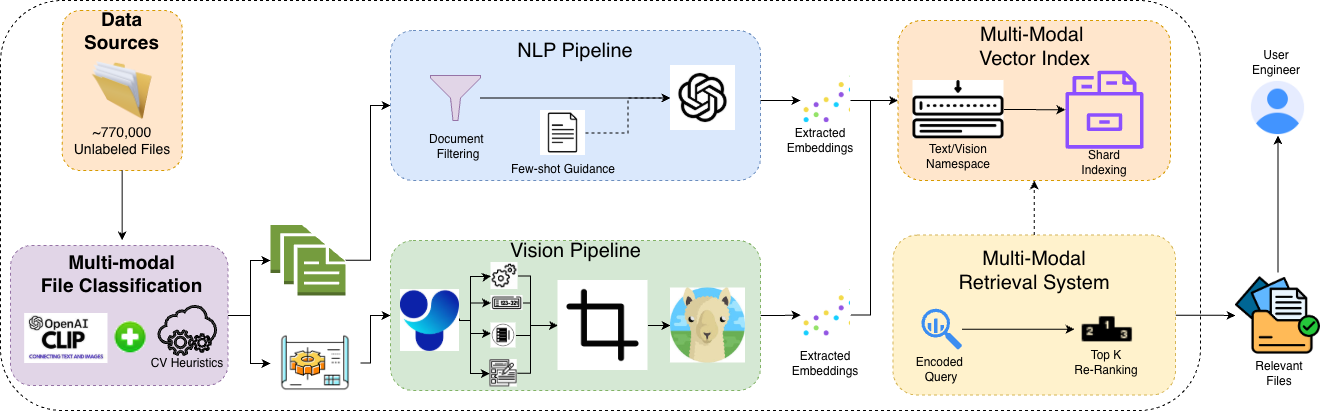
BLUEPRINT first separates drawings from text documents. For drawings, it locates useful regions—such as title blocks and parts lists—and reads those crops. For documents, it extracts text. It combines exact-term and meaning-based search, then reranks matches using regional evidence. [1]
What changed in the results?
Table 3 evaluates 375 queries on a 5,000-file benchmark. BLUEPRINT achieves 71.5% Success@3 versus 62.3% for LLaMA 3.2 Vision: a 9.2-percentage-point increase. Its nDCG@3 is 0.626 versus 0.521. Success@3 asks whether a relevant result appears in the first three hits; nDCG also rewards ordering. [1]
| System | Success@3 | nDCG@3 |
|---|---|---|
| LLaMA 3.2 Vision | 62.3% | 0.521 |
| BLUEPRINT | 71.5% | 0.626 |
Why it matters
A useful search system should lead an engineer to the evidence they can inspect. Better localization and OCR remain opportunities for improvement. The operational records are not publicly releasable; the paper discusses a separate unrestricted benchmark. [1]